Industry News
China's 5,000 RMB Remittance Rule and Your Virtual Card
China's CDD rule for outbound remittances went live in January 2026. What the 5,000 RMB threshold covers, what it does not, and three lines for virtual card…
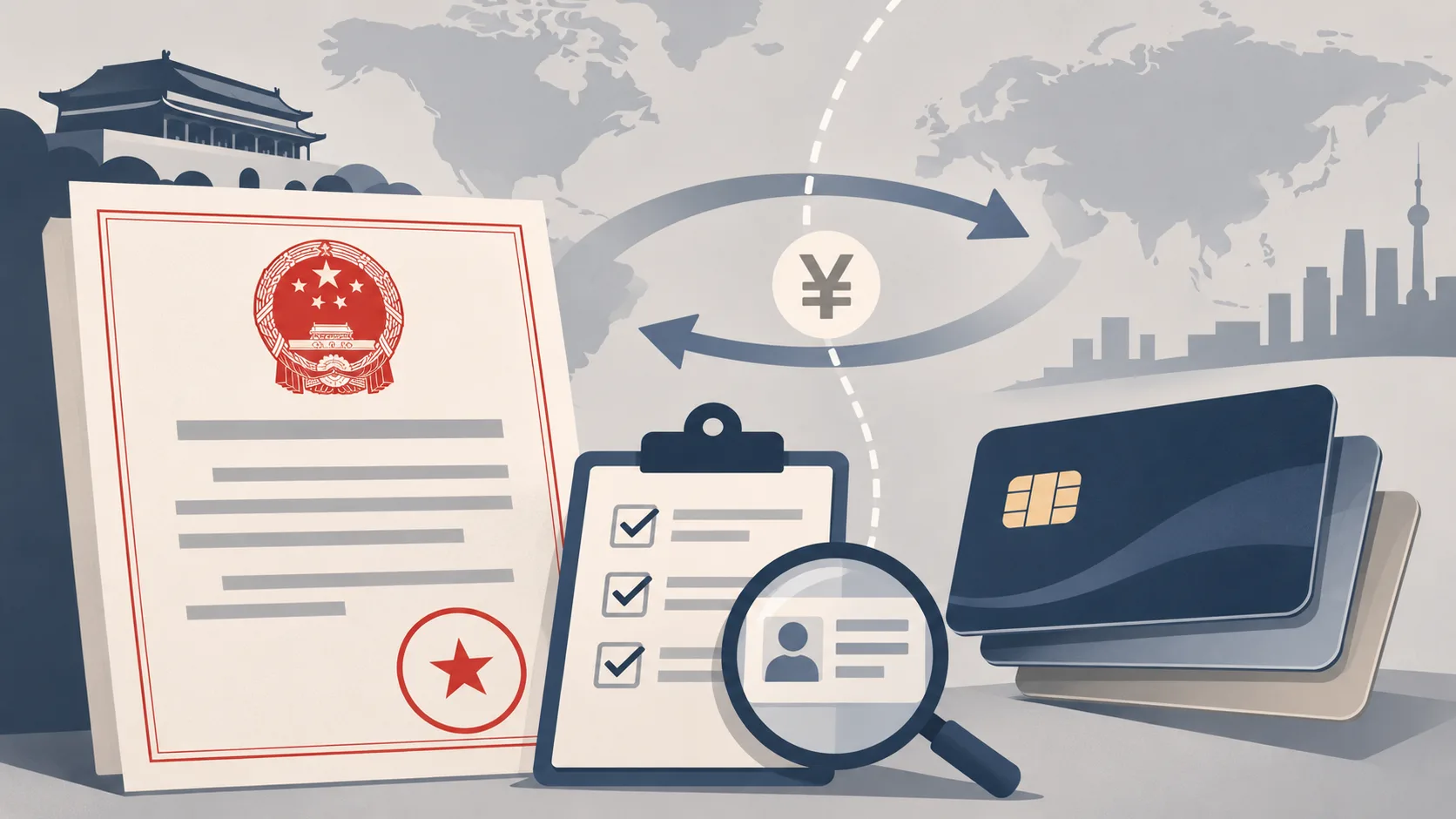
Official documents (bare links, so you can check the wording yourself):
Full text of Order No. 11 [2025], the Measures on Customer Due Diligence and Record Keeping for Financial Institutions, on gov.cn: https://www.gov.cn/zhengce/202606/content_7072629.htm
PBOC regulation library page: https://www.pbc.gov.cn/zhengwugongkai/4081330/4406346/4406348/2025122909302246824/index.html
First, the one thing to get straight: this rule regulates "sending", not "swiping"
On October 31, 2025, the People's Bank of China, the financial regulator (NFRA), and the securities regulator (CSRC) jointly published Order No. 11 [2025]. It took effect January 1, 2026, and repealed the 2007 and 2022 versions of the same rulebook. As of this writing it has been live for about ten months. The versions circulating in expat and fintech forums are wilder than the text. Some claim the 50,000 USD annual forex quota is gone. Others say outbound transfers now get blocked outright. Neither is true.
The actual clause is narrow. When a financial institution or a money-exchange business sends funds abroad for a client, and the amount is 5,000 RMB or 1,000 USD equivalent or more in a single transaction, the institution must verify the accuracy of the remitter's information. Three details matter. One: the rule does not stop at banks. Article 2 explicitly lists non-bank payment institutions as covered entities, which pulls the cross-border exchange business inside Alipay and WeChat Pay into scope. Two: the threshold triggers verification, not prohibition. Transfers under 5,000 RMB are not banned; they simply fall below this tier of identity checks. Three: this is a companion regulation to the new Anti-Money Laundering Law that took effect in 2025. The legislative target is money laundering, not a tightening of forex control.
Here's our read. The panic among virtual card users comes from misreading the rule as "capital exit is being squeezed". What is actually being squeezed is opacity. When you pay a foreign merchant or a subscription charge with a card, that transaction runs on the card networks' acquiring rails. Its legal nature is a purchase, not a remittance, and nothing in this regulation touches the act of swiping. What lands under the magnifying glass is the step that gets money onto the card in the first place.
Ten months in, enforcement is stricter than the text
The regulation says one thing; bank counters do another. Community reports (third-party anecdotes, not official statistics) cluster around a few scenarios. Banks handling outbound remittances ask for purpose documentation: enrollment notices or invoices for tuition, itineraries for travel, sometimes a phone verification before the transfer is processed. There are forum cases of PayPal withdrawals and cross-border moves tripping risk control and getting frozen for a few hours. None of this is written into the rule. It is institutions adding their own safety margin under the "verify the remitter's information" obligation. Strict enforcement does not need a new red-header document. It only needs the possibility of regulatory blame.
The official data tells the other side of the story. Per the State Administration of Foreign Exchange, banks handled 9.2 trillion USD in cross-border receipts and payments on behalf of clients in the first half of 2026, up 21 percent year on year, a record for the period. So the total flow through legal channels is growing. The tightening did not close the gate; it made every passage through it easier to reconstruct. One more clause deserves attention: Article 44 requires institutions to keep customer identity records and transaction records for at least 10 years after the relationship or transaction ends. The full funding chain stays replayable. That is bad news for the channels we will get to next.
The question that actually matters to card users: how does the top-up money leave
A virtual card itself does not move money across a border. The problem is the funding step, and in practice there are three common routes with completely different legal characters.
- Bank purchase-and-remittance. You buy foreign exchange at your bank, wire it to the platform or your own offshore account, then load the card. This route sits squarely inside the new rule: identity verification above 5,000 RMB, materials in order, transaction proceeds. Slow, but clean.
- Direct RMB top-up. The platform shows WeChat and Alipay QR codes on its page; RMB goes in, USD appears on the card. Most convenient for the user. For the platform it means it is operating an RMB on-ramp itself, which is exactly the red-line structure already named by regulators and covered in court cases. We broke down that money flow in "The Two Red Lines of Virtual Credit Cards: the FomePay Case and the 200-Million-RMB Shanghai Prosecution".
- Offshore funds. The money is already outside mainland China: overseas salary, offshore business income, on-chain assets. It goes straight onto the card. No domestic remittance is involved, so this regulation is irrelevant to it, but the safety of your balance depends on the platform's licence and custody setup, which we cover in "Whose Money Is Your Virtual Card Balance? Licence Tiers and Custody Checks".
This deserves blunt wording. The problem with direct RMB top-up channels has never been the fee or the exchange-rate spread. It is that the platform wraps unlicensed cross-border payment into a product feature. Both enforcement cases regulators have publicized describe the same structure: RMB comes in disguised as consumer transactions, then exits through payment channels. The new rule's 10-year record retention, plus payment institutions being pulled into due-diligence obligations, makes every link in that chain easier to replay. A platform can change its domain. The records do not change with it.
Three lines for cardholders in 2026
- Line one: compliant remittance is not banned; it just demands patience. The 50,000 USD annual facilitation quota still exists. If the money is for subscriptions, tuition, or software, keep the invoices and deduction records. The cost of extra paperwork at the counter is far below the cost of explaining a gray-channel transfer later.
- Line two: treat any platform that markets "instant RMB top-up, no forex purchase needed" as a downgrade, not a feature. What it removes is not process, it is compliance. The judgment framework is in the red-lines piece; when we list platforms in this directory, we state the nature of their funding channels explicitly.
- Line three: if your funds are already offshore, the remittance rule is not your problem, platform quality is. Licence tier, balance custody, and withdrawal path are the three things to check, per the custody guide.
A side note for e-CNY watchers. Article 52 of the Measures states that customer due diligence for the digital yuan follows separate provisions. Cross-border e-CNY runs on its own CBETS track (we tested its boundary against virtual cards in "Digital Yuan Goes Cross-Border in 2026"). It runs parallel to the banking system's remittance due diligence. Neither replaces the other anytime soon.
Questions readers actually ask
One misconception first: some people plan to split a transfer into pieces under 5,000 RMB each to dodge the verification. The idea fails at both ends. The threshold only decides whether identity checks trigger, so what you save is a few minutes of process. And several near-threshold transfers in a short window are precisely the splitting pattern that large-transaction and suspicious-transaction reporting systems are built to catch; institutions are obliged to identify and report it. The finer you slice, the higher your explaining cost. The advantage of the compliant route was never convenience. It is explainability.
Does binding a virtual card into WeChat Pay or Alipay count as cross-border remittance? No. Every deduction after binding is a purchase inside the card networks' acquiring system; the obligations sit with the acquiring and issuing sides under their own rules, outside the remittance due-diligence scope. The red line regulators have named was never "binding a card and spending". It is the platform operating its own RMB on-ramp. Confusing those two things is where most panic posts start.
I received a due-diligence notice from my bank. Am I being watched? Almost certainly not. Article 51 requires all legacy clients to be covered within two years; the higher-risk tranche finished its first pass from July 2026, and ordinary customers will receive requests for occupation, income, and purpose in batches. That is the institution doing its compliance homework. Answer truthfully. The signal that warrants actual concern is different: account features restricted plus a demand to explain specific transactions. That is a suspicious-activity check, a different animal.
After this rule, can I still pay for subscriptions like ChatGPT with a virtual card? Yes, and the rule itself never touches the swiping step. The risk concentrates entirely in the funding route. The bank purchase-and-remittance route costs an extra day or two and a modest wire fee. The QR top-up route saves that time and, in exchange, ties your balance and verified identity to a channel that could be prosecuted. Carrying that tail risk for a 20 USD monthly subscription is bad arithmetic.
What to watch over the next two years
Article 51 gives legacy clients a transition window: due diligence on higher-risk existing clients must finish within six months of the effective date (that is, by July 1, 2026), and on all existing clients within two years. Which means through 2028, banks and payment institutions will keep asking long-standing customers for occupation, income source, and transaction purpose. If you receive such a request, there is no reason to panic. It is an institutional compliance action, not a signal that you personally are under investigation.
The inference for the platform side is sharper. An offshore card issuer is not itself subject to this regulation, but its RMB on-ramp partners, the acquirers and payment channels, are. So when you assess a platform's safety going into 2027, three questions carry more information than any cashback rate: What is the funding channel? Is the RMB leg a purchase-and-remittance wire or a QR top-up? Under which licensed entity does the balance sit? A platform that cannot answer them should be treated as high risk.
Concretely, what to do now. If you are still using a QR top-up channel on some platform, draw the balance down to everyday spending levels. If you fund through bank purchase-and-remittance, archive the purpose documents for each wire, at least across your current subscription cycle. If you are an offshore-funds user, run the licence checklist from the custody piece once. What this rule changed is not whether you can spend. It changed how long a shadow each transaction casts.